
Formosa: The Amputation
Part III: In which a dying dynasty loses a war and signs away an island in a sentence

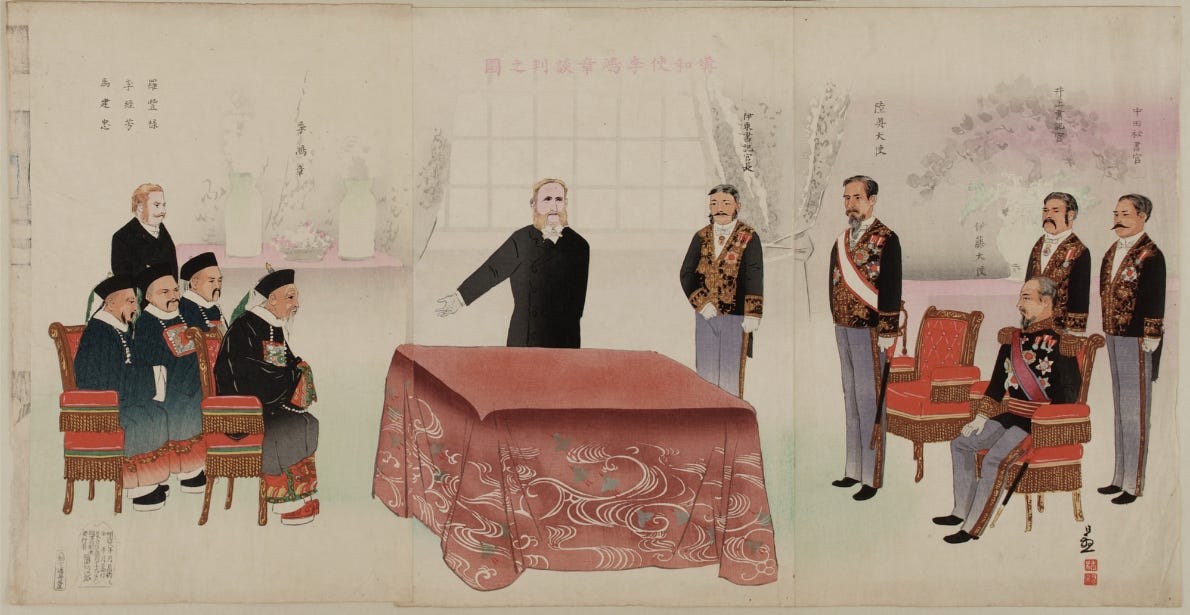
The Shimonoseki Peace Conference, 1895 (Japanese woodblock print): Li Hongzhang and the Qing delegation (left) face Itō Hirobumi and the Japanese delegation (right) at Shimonoseki, April 1895. The treaty ceded Formosa to Japan. The print was made for the victors.
The sentence reads, in its English translation, with the clipped administrative efficiency of a man transferring a car rather than surrendering a civilization: “China cedes to Japan in perpetuity and full sovereignty the following territories: the island of Formosa, together with all islands appertaining or belonging to the said island of Formosa.”
That is it. Twenty-nine words. Signed at the Shunpanrō hotel in the Japanese port city of Shimonoseki on April 17, 1895, by Count Itō Hirobumi for Japan and Li Hongzhang for the Qing dynasty. Taiwan had been a Chinese province for ten years — elevated to that status in 1885, in a belated recognition of its strategic importance — and it was disposed of in a hotel, in a sentence, by men who had never set foot on it, as one line item in a settlement of a war that had largely been fought somewhere else.
The Taiwanese were not consulted. They were not informed until it was done. When they found out, they revolted.
To understand the Treaty of Shimonoseki, you have to understand what the Qing dynasty had become by 1895. It was an empire in the late stages of a long humiliation, the outline of which China’s leaders still invoke today — the Century of Humiliation, Bainian Guochi, which begins conventionally with the First Opium War of 1839-42 and the Treaty of Nanking that followed it, in which Britain extracted trading rights, indemnities, and the cession of Hong Kong from a dynasty that had barely understood what it was fighting. That defeat opened the door. France took Indochina. Russia pressed from the north. Britain returned for more. Germany arrived for its share. The unequal treaties accumulated — not because the Western powers were uniquely wicked, though they were plenty wicked, but because the Qing court had failed to modernise its military, its institutions, or its understanding of what the industrial revolution had done to the global distribution of power.
Japan had understood. The Meiji Restoration of 1868 was the most consequential act of deliberate national transformation in the nineteenth century — a ruling class that looked at the fate of China under Western pressure, concluded that the choice was modernise or be colonised, and chose modernity with ruthless efficiency. By 1894, Japan had a modern navy, a conscript army trained on Prussian lines, and an appetite for empire that it justified, with a fluency that Western powers found flattering, in the language of civilisational progress and strategic necessity. It wanted Korea, which sat between the Japanese archipelago and the Chinese mainland and had been a Chinese tributary state for centuries. When a peasant rebellion in Korea in 1894 gave both China and Japan an excuse to send troops, the war that followed lasted less than a year and ended in the complete destruction of the Chinese fleet at the Battle of the Yalu River. Li Hongzhang, who had spent decades building that fleet, watched its annihilation from the shore.
The peace negotiations were not negotiations in any meaningful sense. Japan held all the cards and intended to play them. Prime Minister Itō Hirobumi presented his terms and declined to negotiate them in any substance. Li Hongzhang attempted to resist the Taiwan cession specifically — the Qing had actually recognised, belatedly, the island’s commercial and strategic value, and Chinese scholars and officials vigorously opposed giving it away. Itō refused to yield the point. Taiwan was, from the Japanese perspective, a gateway to Southeast Asia and the southern Pacific, part of a “southern strategy” that Japan’s military planners had been developing for years. They wanted it and they said so and there was nothing Li could do about it. He signed.
The cession ceremony, when it came, was held on board a Japanese warship in the harbour. The Chinese delegate had requested a shipboard venue because he feared reprisal from local residents if he set foot on shore. This is a small detail and a large one simultaneously.
What happened next on the island itself is largely absent from the version of this history that both Beijing and Taipei prefer to tell.
When the news of the cession reached Taiwan, the local leadership declared the island an independent republic — the Republic of Formosa, established May 25, 1895 — in a desperate gambit to delay the Japanese takeover and invite Western intervention. It was the first republic declared in Asia. It lasted twelve days. Its president fled to the mainland. Its military commander held out in the south for a few months before also escaping. Between two hundred thousand and three hundred thousand people left Taiwan in 1895, mostly Qing officials and the mainland-connected elite. The Japanese military encountered armed resistance for five months after landing, and partisan attacks continued for years afterward.
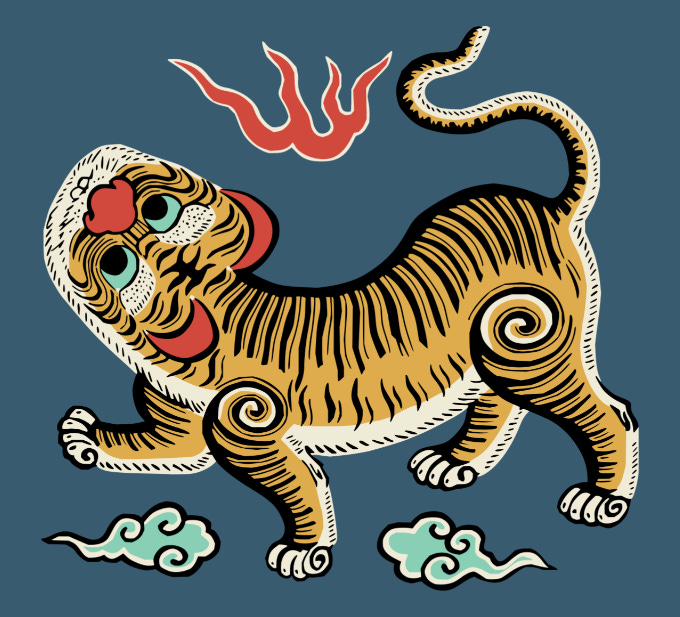
The tiger flag of the Republic of Formosa, 1895. The first republic declared in Asia. It lasted twelve days.
Beijing’s preferred narrative of this period emphasises the cession itself as the wound — Japan’s theft of Chinese territory, the imperial aggression that must eventually be healed by reunification. This is the framing Cheng Li-wun deployed in Nanjing. It has emotional and historical validity. Japan did take Taiwan by force, as a consequence of a war fought over Korea, in a treaty signed under duress by a dynasty in its terminal decline.
What the Beijing narrative tends to omit is the Republic of Formosa — the first assertion of Taiwanese self-determination, however brief and however chaotic, in which the local population declined to accept transfer to Japan and attempted to constitute themselves as something other than a possession to be traded between empires. That assertion failed. But it happened. The people of Taiwan tried, in 1895, to have a say in their own fate. They were ignored then as they are largely ignored now.
Taipei’s preferred narrative, particularly the DPP version, sometimes overstates the continuity between 1895 and the contemporary independence movement — the Republic of Formosa lasted less than two weeks and was led by Qing officials who explicitly claimed loyalty to the Qing emperor even as they declared independence. It was not a nationalist movement in any modern sense. But it was something: the first recorded instance of Taiwan’s people attempting to determine their own status, rather than having it determined for them.
Japan ruled Taiwan for fifty years. This fact sits awkwardly in the middle of every contemporary argument about the island’s identity, because fifty years is long enough to shape a culture profoundly, and because the Japanese colonial record in Taiwan was genuinely mixed in ways that make simple moral accounting difficult.
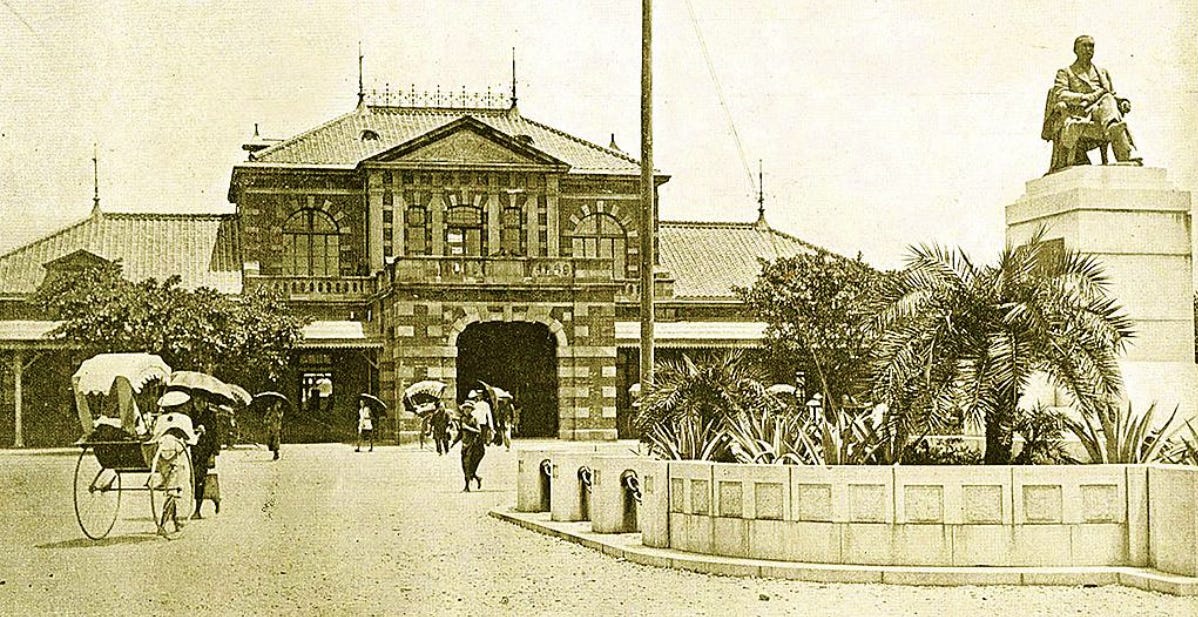
Taipei railway station, Japanese colonial era, c. 1910–1920. Japan built Taiwan's railways, irrigation systems, schools, and public health infrastructure. These were not gifts.
Japan industrialised Taiwan. It built railways, roads, schools, hospitals, and irrigation systems. It introduced modern land registration, a functioning civil service, and public health infrastructure that reduced mortality rates dramatically. By the time Japan surrendered in 1945, Taiwan’s literacy rate was among the highest in Asia, and its infrastructure was substantially more developed than the mainland’s. These were not gifts — they were instruments of colonial extraction, built to serve Japanese imperial interests. Taiwan’s sugar and rice fed Japan. Taiwan’s ports served Japanese trade routes. Taiwanese men were conscripted into the Japanese military during the Second World War. But the infrastructure was real, and it stayed, and it shaped what Taiwan became.
Japan also committed atrocities. The suppression of the 1895 resistance was brutal. Indigenous Formosans were treated, in the Japanese colonial classification system, as subhuman under international law — their forests were seized, their land was expropriated, their communities were dismantled. The Wushe Incident of 1930, in which indigenous Seediq people killed Japanese colonial officials and their families and were subsequently massacred in retaliation, is one of the bloodiest episodes in Taiwan’s colonial history. Taiwanese political autonomy was suppressed. Cultural assimilation was enforced, sometimes violently.
The result, by 1945, was a Taiwan that was deeply marked by Japanese influence — linguistically, institutionally, architecturally, culturally — and that was, in many important respects, more different from the mainland than it had been in 1895. Fifty years of Japanese colonial modernity had produced a Taiwanese identity that was neither simply Chinese nor simply Japanese but something distinct, rooted in the island’s particular history of having been shaped by every power that had ever passed through it.
The relevance of all this to 2026 is not merely historical. It is structural.
When Xi Jinping invokes the Century of Humiliation and the need to restore China’s territorial integrity, he is invoking 1895 and the Treaty of Shimonoseki specifically. The wound that Cheng Li-wun gestured toward in Nanjing is this wound — the cession of an island in twenty-nine words by a dying dynasty that had no choice. The emotional power of that wound is real. China was humiliated. Taiwan was taken by force. The historical grievance is legitimate.
But the argument that healing that wound requires bringing Taiwan’s twenty-three million people under the authority of a government they have never lived under, did not elect, and cannot remove is a different argument, and it does not follow from the historical one. The wound of 1895 was inflicted on the Qing dynasty, which no longer exists, by the Japanese Empire, which also no longer exists, and its healing, if that is the right word, was arguably accomplished when Japan surrendered in 1945 and relinquished all claim to the island. What happened after 1945 — who got Taiwan, under what legal authority, and whether the people on it had anything to say about it — is an entirely separate question, one that the Century of Humiliation narrative tends to swallow whole.
Li Hongzhang signed away Taiwan in a hotel in Shimonoseki in 1895 because he had no choice. The people of Taiwan were not in the hotel. They were not asked. They declared their own republic when they found out, and it lasted twelve days, and then the Japanese came ashore with their modern army and their southern strategy and the matter was settled by force.
The pattern, as the seventeenth century taught us, has always been the same.
Next: Formosa: The Deliberate Void — Part IV: In which the victors of World War II build ambiguity into the peace on purpose
Series Navigation
Series Preface — Formosa: The Beautiful Problem
Part I — Formosa: The Speech in Nanjing
Part II — Formosa: Before the Wound
Part III — Formosa: The Amputation (you are here)
Part IV — Formosa: The Deliberate Void
Part V — Formosa: The Case for Independence
Part VI — Formosa: The Case for Reunification
Part VII — Formosa: The Silicon Shield
Part VIII — Formosa: The Proof of Concept
Part IX — Formosa: Trump’s Auction
Part X — Formosa: The Flag in Tokyo
Part XI — Formosa: The Beautiful Problem